Excel cells are the fundamental building blocks of spreadsheets—they can't be divided further on their own. But what if you need a single header spanning multiple columns, with individual cells below it? That's where merging comes in.

Merging cells combines two or more adjacent cells into one larger cell, ideal for creating column headers or labels that span multiple columns. This formatting technique creates tidier, more professional spreadsheets. For example, merge cells A1, B1, and C1 to form a header, then enter data normally in the rows below.

Select two or more adjacent cells you want to merge.
Go to Home > Merge & Center.
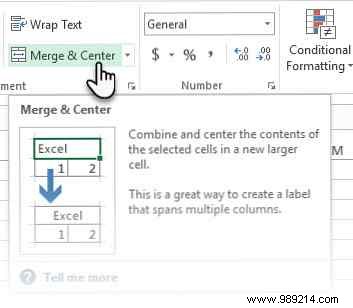
If Merge & Center is grayed out, ensure you're not editing a cell and the cells aren't inside a table.
To merge without centering, click the dropdown arrow next to Merge & Center, then choose Merge Across or Merge Cells.

Note: When merging cells with data, only the top-left cell's content is kept; others are deleted. Adjust alignment using the Alignment group on the Home tab.
You can easily unmerge cells at any time. To find merged cells quickly, use the Find command.
Select the merged cell.
Click Home > Merge & Center, or the dropdown arrow and select Unmerge Cells.
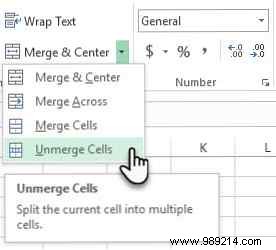
The cells separate, with data moving to the top-left cell.
Merging enhances spreadsheet readability and sets the stage for advanced features like conditional formatting. Excel's conditional formatting automatically styles cells based on values—perfect for data analysis. Read more. Always plan ahead to prevent data loss; for preserving all data during merges, advanced formulas are available.
